
Website Migration Done Right: How Laufer Trucking Kept Its SEO
June 22, 2026
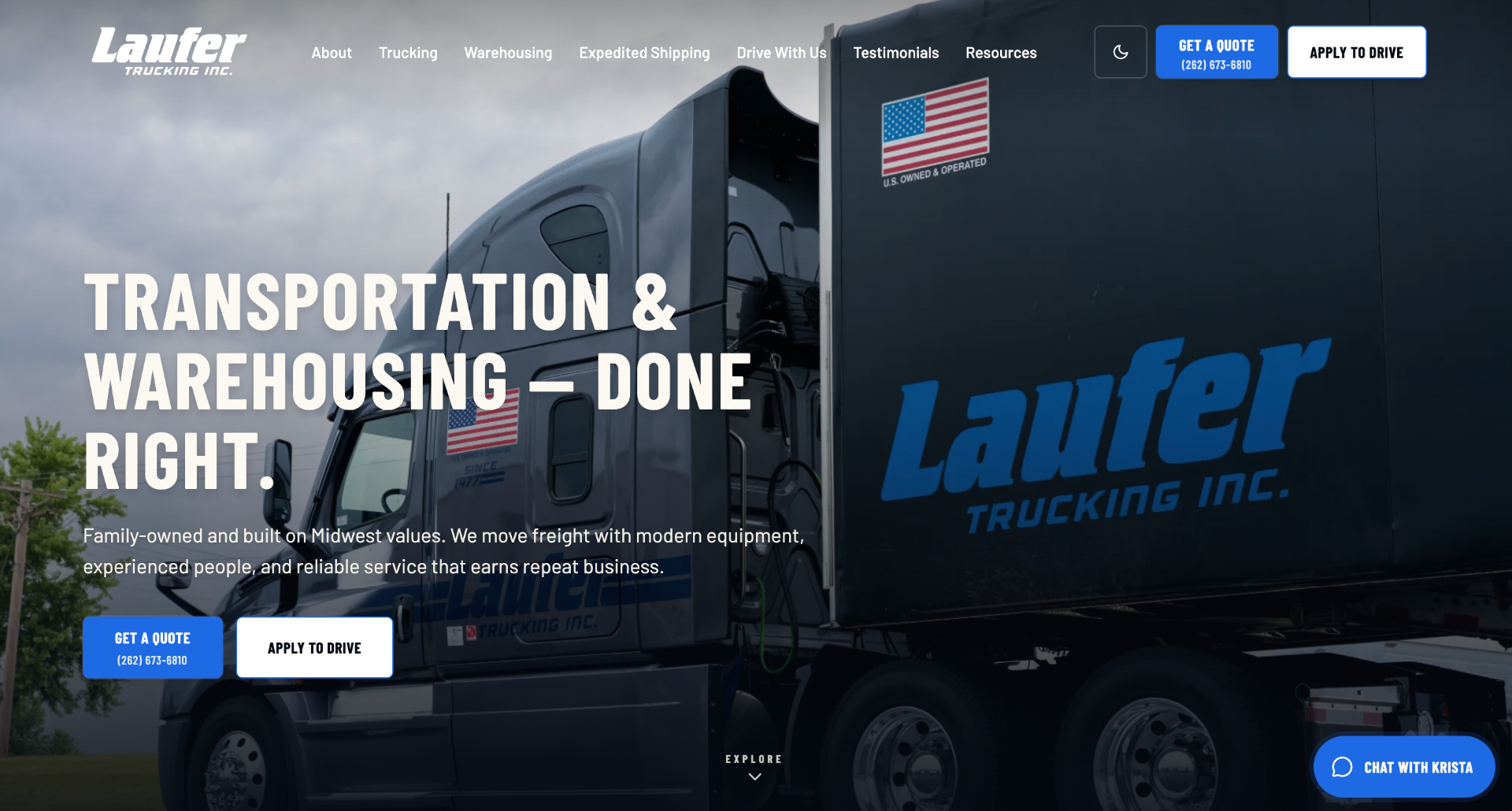
Worried a rebuild will tank your Google rankings? Here's how Laufer Trucking migrated off aging WordPress without losing 25 years of SEO equity.
Most business owners know their website needs to be rebuilt. They've been told for years that it loads slowly, the layout is dated, and the lead forms don't work properly. They keep putting it off anyway, and the reason almost always comes down to one fear: what if the rebuild tanks our Google rankings?
It's a reasonable fear. A site with twenty-five years of search equity is genuinely valuable, sometimes worth more than the business assets sitting in the parking lot. Losing those rankings can mean losing the phone calls and quote requests that pay the bills. So owners stay on old WordPress installs that load slowly, look tired, and capture half the leads they should be capturing.
Laufer Trucking was in exactly that position. Here's what happened when they decided to migrate anyway, and why their rankings did not move.
The setup at Laufer Trucking
Laufer Trucking is a family-owned trucking, warehousing, and freight brokerage company in Hartford, Wisconsin. The business has been operating since 1977, one truck at a time, and online for 25 of those years. Over that quarter-century, the site picked up 433 inbound links from suppliers, partners, industry directories, and trade publications. Each one was a small SEO deposit. Together they were a substantial part of why the business showed up in Google when shippers searched for trucking and warehousing in southeastern Wisconsin.
The site itself, though, was aging. WordPress installs that have been running for two decades pick up plugins, theme tweaks, and security debt. The Laufer site loaded slowly. The forms were finicky. The photography did not match the quality of the operation. And the architecture was not built for how Google and AI search engines look at content today.
Krista Laufer, second-generation owner and the person running day-to-day operations, was driving the conversation about what to do next. The owners wanted a modern site. What they could not afford was the standard rebuild disaster: a brand new site that loses its rankings overnight, drops the broker calls for six months while everything reindexes, and burns through the link equity built over decades.
Krista's first instinct, in fact, was not to rebuild at all.
At first, we weren't planning to rebuild our website. After discussing our options and evaluating our existing site, it became clear that we weren't positioned to compete effectively in today's digital environment.
— Krista Laufer, Laufer Trucking
What we did differently
The migration plan came down to three rules, and the rules drove every technical decision.
First rule: every working URL gets a redirect to its new home. We built a complete 301 redirect plan that mapped every URL with inbound external links to the new site structure. All 433 backlinks were preserved through the migration. When a directory or supplier site sent traffic to an old Laufer URL, Google followed the redirect to the new page and the link equity passed along. No 404s, no broken referrals, no dropped equity.
Second rule: the new site has to render everything in HTML on the server, not in the browser. We built the site on a modern React-based stack with full server-side rendering, so every blog post, every equipment page, every service description is in the raw HTML response. Google sees the content. AI search engines like ChatGPT and Perplexity see the content. Crawlers that don't run JavaScript see the content. This is a real difference from typical single-page-app rebuilds, where the page is mostly empty until the JavaScript runs. Those sites can rank eventually, but they fight an uphill battle and often disappear from AI search entirely. Laufer Trucking did not have decades to spare on that fight.
Third rule: the forms have to work before launch. Quote requests and driver applications were built, wired to the client's inbox, and tested end-to-end days before cutover. When the new site went live, the lead capture worked from the first visitor on, not after we got around to debugging the email configuration.
What happened on launch day
The cutover was clean. Zero downtime. Old site off, new site on, redirects active, forms tested live.
Within hours of launch, the new site was ranking number one in Google for the brand-name search. That's the specific claim, made precisely: brand-term ranking, fast. Broader keyword rankings, the harder competitive queries like 'trucking company Hartford WI' or 'warehousing southeastern Wisconsin,' build over weeks as Google recrawls and re-evaluates the new site against incumbent competitors. That's how migrations always work, and we set that expectation up front. The brand-term ranking is the canary, and on launch day the canary was singing.
The first quote requests came in within the first week. The driver applications followed. Both arrived in the inbox they were supposed to be in, formatted correctly, with the source page identified so Laufer knew which marketing channel was working. Faster page loads, upgraded photography from a recent shoot, and content that actually described the operation accurately. The site finally matched the company. Start to finish, the project ran about a month. The live result is at laufertrucking.com.
Our new website is amazing. It's visually appealing, content-rich, and does an outstanding job representing who we are as a company. Even more impressive, the entire project was completed in about a month from start to finish.
— Krista Laufer, Laufer Trucking
Why this matters for any service business considering a rebuild
Rebuilding a working website is a special category of risk. The site you have, no matter how dated, is producing leads, sitting in directory listings, and ranking somewhere in Google. A bad migration can wipe out all of that in one weekend.
The fix is not to avoid migrating. The fix is to migrate carefully, with the three rules above as non-negotiable. Map the redirects. Render the content on the server. Test the forms before launch. Done right, you trade an aging site for a faster, better-converting one without losing the search equity you spent twenty years building.
If your site is more than five years old, on WordPress or any legacy CMS, and you've been putting off a rebuild because the SEO risk feels too high, the risk is real but manageable. The companies that get this wrong skip steps. The companies that get it right plan the migration as carefully as the build itself.
Great Wave runs a free site and migration review for service businesses considering a rebuild. We pull your current SEO baseline, map your top inbound links, and tell you what a clean migration would look like for your specific site. No pressure, no pitch. Book a review at greatwave.pro/get-started.